I have found many websites and apps that help save money when making purchases, or otherwise help make money by doing simple tasks. While none of these will make you rich fast or replace income from a regular job, it can be a nice supplement. Since I am always looking for ways to save, I love these little ways to save/make money.
Disclaimer: This post contains affiliate links, which means I may receive compensation if you register with a website/app using these links. There is no cost to you. See my Disclosure Policy for more information.
Swagbucks is my favorite way to make money online. Through this money making app and website, you complete activities to earn points, which can be redeemed for gift cards. There are many ways to earn points through the app and the website, including taking surveys, watching videos, clicking links from the Swagbucks website to retailer websites before making a purchase, and more. I use the app on my phone and have it play videos when I’m not using my phone. When on my computer I play videos in the background or click through other activities. Every day there is a “Daily Goal” of points to earn, and you get a bonus if you complete that goal. You get more bonus points if you meet your goal for 7, 14, 21 consecutive days, or all days in a month. Using this app I make about $50-$75/ month in gift cards. Examples of gift cards available are Amazon; various restaurants; airlines; cruise lines; gas stations; retail stores including clothing, drug, pet, and electronics stores; and more.
Ebates allows you to earn cash back shopping at online retailers when you navigate to the retailer website through the Ebates website or app. Earnings are paid every 3 months, as long as you have earned over $5 during the previous quarter. My first year using this site I earned over $70. More recently I have earned slightly less, as I shop around to determine which website provides the most cash back from my purchase (see items 1 and 6 in this list). Overall it is still a great money saving app/website.
This is a money saving app for your smartphone. With this app, you just take pictures of all your store receipts. Everything, except gas and restaurant receipts, is worth points; receipts not eligible for points are eligible for “spins” which may results in points. When you earn enough points you can cash it in for Amazon gift cards, money to your Pay Pal account, or magazine subscriptions.
Ibotta is a money saving app has rebates for specific retailers. There are many grocery and drug stores as well as other retailers such as clothing and electronics. After making a purchase, you scan the barcode of the eligible product then take a picture of your receipt. This app mostly has rebates for brand name products, but most weeks there are one or more “any brand” produce, dairy, and/or meat items, which is where I make most of my money with this app.
This is another money saving app like ibotta, but rebates can either be for a specific store or any store. I like this one because every week there is at least 1 “pick your own” offer for $0.25 off one of 4 or 5 produce items. The other items are name brand so I use those less frequently.
Bank and Credit Card Reward Websites
Bank and credit card reward websites. Many credit card companies have websites that will give you cash back on purchased when you navigate to online retailer websites and make a purchase (like how you earn cash back with Ebates, and one way to earn points with Swagbucks. Navy Federal Credit Union has a Member Mall for credit card customers. Southwest Airlines Rapid Rewards has a shopping page for credit card customers.
Retailmenot.com is my favorite website for finding coupon codes and printable coupons for online and brick-and-mortar stores. Almost everywhere I shop has a page on retailmenot, and I have never found a coupon that was NOT on the retailmenot page. This is my one stop shop for online coupons!
Do you have other apps or websites that you like to use to save or earn money?
I was thrilled with my first batch of homemade bar soap, but found that it was used up more quickly than I expected (or wanted). I set out to make a bar soap that lasted longer than my first batch, but still had the nice lather and silky feel. Longer lasting soap means that the soap bar is harder. I found All About Soap-Making Oils to have some very good high level information about selecting oils for making soap. The Secret to the Absolutely Best Soap Recipe offered suggestions about increasing soap bar hardness, including increasing the ratio of hard to soft oils, and adding sodium lactate. How to Make Handcrafted Soap Harder discussed ratio of hard to soft soaps, using castor oil, decreasing superfat %, adding sodium lactate or salt, all of which can increase the soap bar’s hardness. I haven’t tried sodium lactate or salt in my recipes yet, but plan to in my next batch. I’ll report on that after my experiments!
Disclaimer: This post contains affiliate links, which means I may receive compensation if you make a purchase through these links. There is no cost to you. See my Disclosure Policy for more information.
After doing my research and raiding my closet to see what oils and butters I already had on hand, I went over to soapcalc.net and formulated this bar soap recipe. It is fragrance free, 3% superfat, water as a percent of oils 38%, and I decided to use black tea in place of water. I made this recipe cold process.
Why use tea instead of water in soap making? Maybe some of the antioxidants in the tea survive the soap making process and my skin can benefit from this. Even if not, I experimented with something new, and ended up with interesting colored soap!
This recipe is for a 2 kilogram batch of homemade bar soap. You can adjust the amount of soap you make by keeping the same ratios I have listed, and using soapcalc.net to calculate the amount of water and lye needed.
Black Tea Soap
Fragrance-free soap made with olive oil, coconut oil, castor oil, cocoa butter, and black tea
760.00gramsdistilled water26.81 oz or liquid of choice (I brewed tea with 4 black tea bags)
290.20gramsSodium Hydroxidelye (10.24 oz)
100gramsCastor Oil3.53 oz (5% of oil weight)
100gramsCocoa Butter3.53 oz (5% of oil weight)
600gramsCoconut Oil76 deg (21.16 oz) (30% of oil weight)
1200gramsOlive Oil42.33 oz (60% of oil weight)
Supplies
immersion blender
large glassceramic, or steel container for mixing soap
glassceramic, or steel bowls or measuring cups for measuring ingredients
microwavecrock pot, or stove for melting oils
kitchen scale
silicone spatula or wooden spoon
soap moldcan be as simple as a box or pringles tube lined with wax paper
glovessafety glasses
Instructions
1. If using tea in place of water, the day before you plan to make soap, brew the tea. Measure slightly more water than needed in your recipe, and heat to a boil. Remove the water from heat and place tea bags in the water. I used 4 regular size tea bags, and let steep for about 1 hour. I wanted dark tea for the color. Remove tea bags, and leave the tea at room temperature, or place in the fridge to chill. From my 2 batches, chilled tea resulted in darker finished product.
2. Prepare your soap molds.
3. Measure the tea by weight, pouring into a glass, ceramic, or steel vessel. If you do not have enough tea, add distilled water until you reach the desired weight of liquid. Ensure that your tea is room temperature or cooler (see note below).
4. Place the container with the tea in a well ventilated area where it will not be disturbed. I use my sink with the nearby window open. Wearing safety glasses and gloves, carefully measure the lye. Slowly pour the lye into the tea and stir gently with a wooden spoon or silicone spatula to dissolve.
5. Measure the oils into a large glass, ceramic, or steel container. Heat slowly until the solid oils are fully liquefied. I use the ceramic pot from my crock pot, and heat either in the crock pot on "warm" or "low", or I microwave the pot with oils.
6. Carefully pour the lye solution into the oil solution. Using an immersion blender, blend the solution until achieving trace, typically 3-5 minutes. Trace means that all of the lye is fully mixed in with the oils, and is achieved when the solution has a cake batter to pudding-like consistency; when the blender is lifted out of the soap and drizzles on the surface, traces of the drizzles stay on the surface.
7. Pour the soap into molds and place somewhere that the molds can be left undisturbed for 24 hours. I have used a closet and my microwave. At this point the lye is still present in the soap, so use care not to touch it.
8. After 24 hours, you may test the soap to determine if it has fully saponified. I use the "tongue test" - touch the tip of your tongue to the soap. If you feel a zap - like touching your tongue to a 9 volt battery - the saponification process is not yet complete, and you should leave the soap for several more hours.
9. Remove the soap from molds and cut to your desired size. The soap is still somewhat pliable at this point, so be careful not to make undesired marks with your tools or fingers. You can also use this time to smooth edges on your soap.
10. Place the soap bars to dry. I line a large shallow box with waxed paper and stand the bars up on end with space between each bar. Allow the soap to dry at least 6-8 weeks before using. Longer dry times should result in harder soap bars that last longer.
Notes
If the tea is chilled in the refrigerator before combining with the lye, it will result in a darker bar of soap. If you use room temperature tea, the bar will be a tan color, but lighter than cold tea soap. Please NEVER use hot tea as the reaction of water (or tea, in this case) and lye is exothermic (produces heat), and starting with hot liquid could result in boiling lye-water, increasing the danger of working with lye.
Ingredients
760.00 grams distilled water (26.81 oz) or liquid of choice (I brewed tea with 4 black tea bags)
290.20 grams Sodium Hydroxide (lye) (10.24 oz)
100 grams Castor Oil (3.53 oz) (5% of oil weight)
100 grams Cocoa Butter (3.53 oz ) (5% of oil weight)
600 grams Coconut Oil, 76 deg (21.16 oz) (30% of oil weight)
1200 grams Olive Oil (42.33 oz) (60% of oil weight)
Supplies
immersion blender
large glass, ceramic, or steel container for mixing soap
glass, ceramic, or steel bowls or measuring cups for measuring ingredients
microwave, crock pot, or stove for melting oils
kitchen scale
silicone spatula or wooden spoon
soap mold (can be as simple as a box or pringles tube lined with wax paper)
gloves, safety glasses
Instructions
If using tea in place of water, the day before you plan to make soap, brew the tea. Measure slightly more water than needed in your recipe, and heat to a boil. Remove the water from heat and place tea bags in the water. I used 4 regular size tea bags, and let steep for about 1 hour. I wanted dark tea for the color. Remove tea bags, and leave the tea at room temperature, or place in the fridge to chill. From my 2 batches, chilled tea resulted in darker finished product.
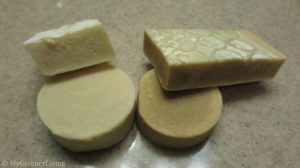
Room temperature tea made the bars on the left, chilled tea made the bars on the right
Prepare your soap molds.
Measure the tea by weight, pouring into a glass, ceramic, or steel vessel. [Measurement by weight is critical for soap making, to ensure you do not end up with unsaponified lye in your soap. If you don’t have a digital kitchen scale, I personally love and recommend this American Weigh Scales digital kitchen scale.] If you do not have enough tea, add distilled water until you reach the desired weight of liquid. Ensure that your tea is room temperature or cooler (see note below).
Place the container with the tea in a well ventilated area where it will not be disturbed. I use my sink with the nearby window open. Wearing safety glasses and gloves, carefully measure the lye. Slowly pour the lye into the tea and stir gently with a wooden spoon or silicone spatula to dissolve.
Measure the oils into a large glass, ceramic, or steel container. Heat slowly until the solid oils are fully liquified. I use the ceramic pot from my crock pot, and heat either in the crock pot on “warm” or “low”, or I microwave the pot with oils.
Carefully pour the lye solution into the oil solution. Using an immersion blender, blend the solution until achieving trace, typically 3-5 minutes. Trace means that all of the lye is fully mixed in with the oils, and is achieved when the solution has a cake batter to pudding-like consistency; when the blender is lifted out of the soap and drizzles on the surface, traces of the drizzles stay on the surface. I didn’t get any pictures of this, but if you’re unsure if you’re there, read this SoapQueen post.
Pour the soap into molds and place somewhere that the molds can be left undisturbed for 24 hours. I have used a closet and my microwave. At this point the lye is still present in the soap, so use care not to touch it.
After 24 hours, you may test the soap to determine if it has fully saponified. Several methods are described here; I use the “tongue test” – touch the tip of your tongue to the soap. If you feel a zap – like touching your tongue to a 9 volt battery – the saponification process is not yet complete, and you should leave the soap for several more hours.
Remove the soap from molds and cut to your desired size. The soap is still somewhat pliable at this point, so be careful not to make undesired marks with your tools or fingers. You can also use this time to smooth edges on your soap.
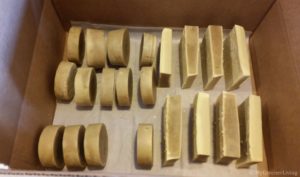
Place the soap bars to dry. I line a large shallow box with waxed paper and stand the bars up on end with space between each bar. Allow the soap to dry at least 6-8 weeks before using. Longer dry times should result in harder soap bars that last longer.
black tea soap drying
Note: If the tea is chilled in the refrigerator before combining with the lye, it will result in a darker bar of soap. If you use room temperature tea, the bar will be a tan color, but lighter than cold tea soap. Please NEVER use hot tea as the reaction of water (or tea, in this case) and lye is exothermic (produces heat), and starting with hot liquid could result in boiling lye-water, increasing the danger of working with lye.
Cost
Castor Oil- $9.49 for 16 fl oz (470.6g) on Amazon. (100g/470.6g)x$9.49=$2.02
Cocoa Butter- $15 for 1 lb (453.59 g) on Amazon. (100g/453.59g)x$15=$3.31
Coconut Oil – $14.99 for 54 oz (1458.99 g) at BJ’s Wholesale Club. (600g/1458.99g)x$14.99=$6.16 (or $16.99 on Amazon)
Olive Oil – $13.99 for 1.82 liters (1688.96 g) at BJ’s Wholesale Club. (1200g/1688.96g)x$13.99=$9.94 (or Amazon)
Distilled water – $0.98 for 1 gallon (3,785.41 grams) at Walmart. (760g/3785.41g)x$0.98=$0.20
Tea Bags – $3.99 for 100 black tea bags at Ocean State Job Lot. (4 tea bags/100 tea bags)x$3.99=$0.16 (Amazon)
Total cost is $21.79 for 2 kilograms or 70.5 ounces. This equates to $0.309 per ounce, or $1.24 for a 4 ounce bar of soap. For comparison, I can get Kirk’s coco castile soap for $3.28 for 3-4oz bars at Walmart, which is $1.09 for a 4 oz bar. A 6 pack of Dove 4 ounce bars is $6.88, or $1.15 per 4 oz bar. This soap costs marginally more, but feels nicer on my skin, and has only high quality, chemical-free ingredients. Well worth the price, to me!
Have you ever made soap? Do you have any favorite recipes?