Easy Sweat Stain Buster Recipe

I am all about saving money and the environment by buying quality items and trying to make them last.  Many times I have seen my and my family’s clothing stained, and I questioned whether I could clean and therefore salvage the garment.  In this post I share a simple, 3-ingredient recipe for removing the yellow stains that often plague the collar and armpits of shirts.  This sweat stain remover has saved me many garments and much money over the years!


Disclaimer: This post contains affiliate links.  See my Disclosure Policy for more information.
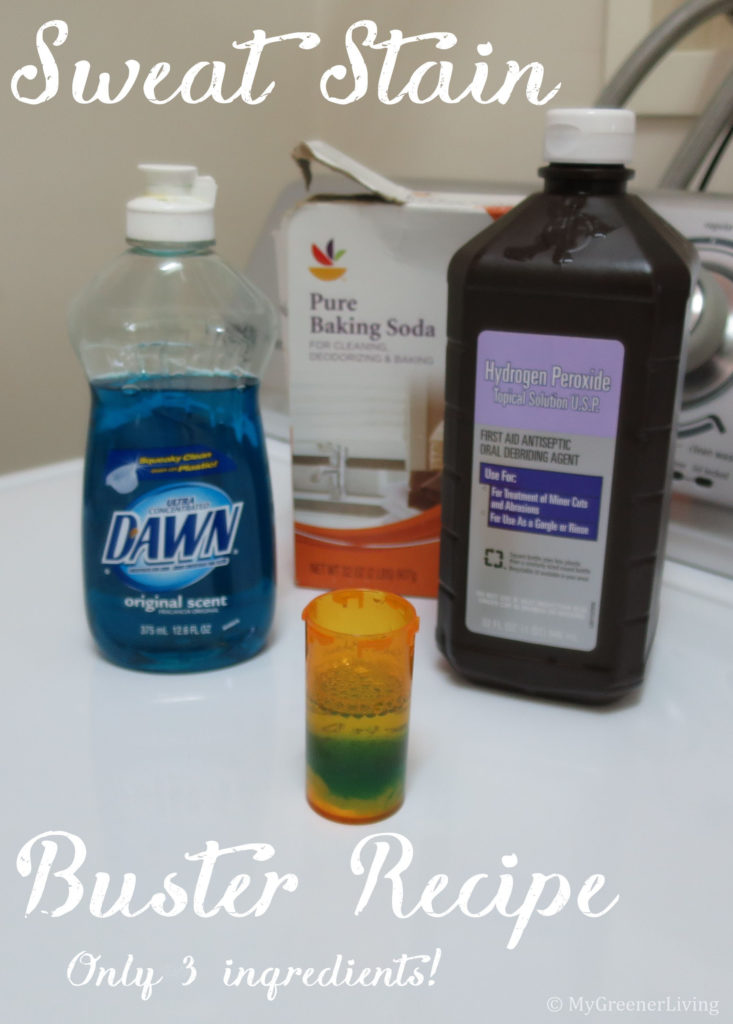

Sweat Stain Buster Recipe

The most common cause of this yellow stain, that I often find on shirt collars and shirt armpit areas, is sweat.   But I also have found that the oily natural sunscreens can leave a yellowish residue on clothing, too.  Don’t get me wrong, I still love these natural sunscreens, but I now can use them without worrying about destroying my clothing as I protect my skin!

The Sweat Stain Remover Recipe
Ingredients

1 tsp Dawn Original Dish Detergent

1 tsp Baking Soda

2 tsp Hydrogen Peroxide (3%)

Sweat Stain Buster shirt - before
stained shirt collar
Using the Sweat Stain Remover

To use this sweat stain remover, I mix 1 teaspoon Dawn, 1 teaspoon baking soda, and 2 teaspoons hydrogen peroxide.  Once I have the ingredients mixed together well, I use a toothbrush dedicated to laundry apply a small amount to the stained area.  I use the toothbrush to work the solution into the stained fabric.  If the fabric is thick or I just don’t feel like I am able to work the solution into the stain well, I sprinkle a little water to thin, then keep working it into the stain.

I allow this to soak on the stain overnight (12-24 hours) then launder as usual, without rinsing before putting the clothing in the washing machine.

NOTE about possible staining:  I have had Dawn stain light colored natural fabrics (cotton), so when using this solution (or any other that use Dawn) I wet the fabric with water first, add water to the Dawn solution, and only soak about an hour before rinsing.  I repeat the soak as necessary to remove the stain.

shirt soaking in sweat stain buster
entire shirt soaking in sweat stain remover

I have used this successfully on synthetic (typically polyester) garments with the long soak time, and still with success but more effort with natural fabrics.

Sweat Stain Buster shirt - after
shirt collar – stain removed!
How much do I use?

Well this is a tough question to answer.  It really depends on how big the stain is.  The recipe I have here is enough for about 3 shirt collars, but it depends how much of the collar is stained.  I mix this up in small amounts (hence, the above recipe) and if I have any left over I store it in a little container.  I like using a clearly labeled old pill bottle – it doubles as a storage vessel plus an extra barrier to keep kids from getting to the chemicals.

I once turned my white Columbia UPF40 button down yellow from natural sunscreen.  Pretty much all over.  I thought my shirt was ruined.  And unfortunately I forgot to take a “before” picture.  I think I made a 7x batch of this sweat stain remover to soak the entire shirt to try to make it white again.  It worked for the most part – there were a couple panels of a different fabric or different weave that stayed tinged yellow (the panels on each side under the arm pit and down to the bottom hem), but most of the shirt was bright white again after the soak and laundering!  It’s definitely wearable again, and I am thrilled that I was able to salvage this shirt!  I think it has many more seasons of life left, to protect this pasty-pale skin from the sun!
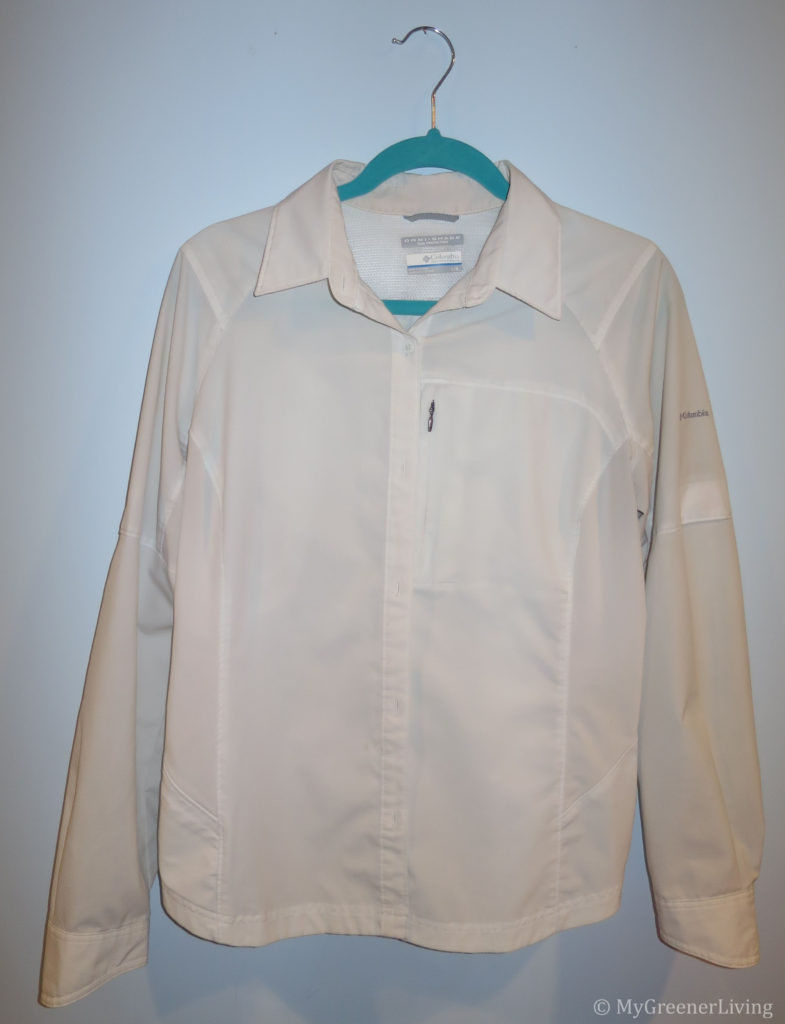
white shirt after soaking to remove natural sunscreen residue
Cost

Again, cost depends on how much you need to use.  To make the sweat stain remover recipe above, it only costs $0.05!

I have found the best prices for these types of common household products to be at Walmart, grocery stores, or drug stores.  If you want to order online, the best prices I found were at Walmart.com.

Dawn Original Dish Liquid. ($2.00/14.6 fl oz)x(1 fl oz/6 tsp)x(1 tsp)=$0.0228

Baking Soda. ($.99/1 lb)x(1 lb/454 g)x(4.8g/1 tsp)=$0.0105

Hydrogen Peroxide (3%).  ($1.00/32 fl oz)x(1 fl oz/6 tsp)x(2 tsp)=$0.0104

Total: $0.0228+$0.0105+$0.0104=$0.0437 ≅ $0.05

before and after treatment with sweat stain buster

Do you have any tips or tricks to salvage dirty or damaged clothing – or other items?  Please share in the comments below!

DIY toilet spray

Shortly after I started scouring the internet for homemade natural recipes, I happened across a recipe for homemade “poo-pourri” – a bathroom or more specifically, toilet spray.  I laughed at this idea, but in the back of my mind, I wondered if it would work.  


Disclaimer:  This post contains affiliate links.  See my Disclosure Policy for more information.


I had forgotten about this idea until I saw a bottle of Poo-Pourri at a friend’s house and decided to try it.  It worked, and I decided I wanted to make some for my home.  

toilet spray - poo pourri

What is toilet spray and how does it work?

Toilet spray is a blend of essential oils and water, that is sprayed on the surface of the toilet water before someone “poos.”  The oil stays on the surface of the toilet water, forming a barrier that prevents things in the water from making the air in the bathroom smell.  Instead, the air smells like the essential oils in the spray.  

toilet spray

Does it really work?

Yes!  I was skeptical that such a small amount of oil (the sprays are mostly water, mine is less than 2% essential oil*) would be able to prevent a smell barrier, but after testing a couple recipes for several months each, I have to say that it works.  When I use this spray, my bathroom does not stink, and occasionally has a slight lingering scent of the essential oils from the spray.  After flushing, I often give the air one spritz of the toilet spray to leave the room smelling extra fresh.  

How do I use the spray?

To use my toilet spray, I spray 4-5 spritzes of my toilet spray onto the surface of the toilet water before I “go.”  

Additional use:  I spray 1-2 spritzes of the toilet spray in the air to freshen the air.  I do this in the bathroom and other rooms of the house.  

Toilet Spray Recipe
toilet spray ingredients
Ingredients
  • glass spray bottle (I always use glass with essential oils – oils can react with plastic)
  • choice of essentail oils – I like lemon, it smells fresh and clean!  I’ve also used peppermint, and a blend of the two.  Lemon alone is my favorite, but really any oil that you like will work. 
  • liquid castile soap (I use a couple squirts of my hand soap made from my castile soap, or a few drops of Dr. Bronner’s)
  • water
Instructions
  1. Drop several drops of liquid castile soap into the spray bottle.  Add 10 drops of essential oil for each ounce that the bottle holds.  I used a 2 fluid ounce bottle, so I added 20 drops essential oil.  Shake the bottle gently to mix the soap and oil.  The solution will look opaque.
  2. Fill the bottle with water.  Put the cover on the spray bottle, and shake gently.  The solution will look opaque.  

That’s it!  The oil should stay blended with the water, due to the castile soap.  Now I just use the spray as I described above!

mixing toilet spray
after step 1

I previously made this recipe using just the water and essential oils, and it worked great for a while, but I had to remember to shake the bottle before each spray, and by the time I had used about 1/3 of the bottle, all of the oil as gone.  This new method blends the oils with the water, and it has not separated after several months.  See how the liquid in the bottle looks opaque?  That is what it looks like when the oil is blended with the water.  If at some point the liquid looks clear – like just water in the bottle – the oil isn’t blended and is more likely to be used up before the water.

toilet spray
after step 2
Cost

Cost for a 2-fluid ounce bottle of toilet spray, using lemon oil:

bottle: Available on Amazon for $9.46 for 12. $9.46/12=$0.788

castile soap: For ease of calculation, I’ll use the price from Amazon – $15.99 for 32 oz. ($15.99/32oz)x(1 oz/600 drops)x(5 drops)=$0.004

lemon essential oil: Available on Amazon for $12.99 for 4 oz.  ($12.99/4oz)x(1 oz/600 drops)x(20 drops)=$0.108

Water: Where I live, water is $10.02 for 1000 gallons.  With 128 oz per gallon, 2 oz water costs: ($10.02/1000 gallons)x(1 gallon/128oz)x(2oz)=$0.00016 (essentially free)

Total cost: $0.90 for 2 oz bottle, including bottle

A 2 oz bottle of Poo-Pourri costs about $10 (and it is in a plastic bottle).  This DIY version is a great price, and is refillable for only about $0.11!


Have you ever tried a toilet spray?  What essential oil scents do you use?  Share with us in the comments below?


Why use castile soap?

If you’re curious about why I use castile soap, here’s the science explanation.  Flash back to high school science!  Oil is hydrophobic – it repels water, due to its molecular structure.  But there are some ways to make it blend with water.  Castile soap – or soaps and detergents in general, act as a surfactant, which means that soap has a molecular structure that is attracted to water on one side of the molecule (hydrophillic), and oil on the other side (hydrophobic).  This is how soap cleans oils from clothing in the laundry, from hands when washing.  The oils are attracted to the soap, so the oils pull away from whatever surface they’re on.  The other side of the soap molecule is attracted to water, and water is attracted to water, so the larger amount of water (vs. oil) used in washing flushes away the soap (attracted to the water) and also the oil (that’s attracted to the soap)!  

Soap
from https://sciencing.com/adding-soap-oil-water-7408600.html

In the toilet spray, the soap and oil are first mixed together to ensure all the molecules bind together.  Then water is added and the the soap/oil arrange themselves with the water molecules to form a liquid that is evenly dispersed oil, water, and soap.  Cool!  This article from planet-science.com is the source of the above image and explains in slightly different words. 


*According to Mountain Rose Herbs, there are about 600 drops of liquid (essential oil – but I the same seems to apply to water) per ounce.  My recipe uses 20 drops essential oil in 2 fluid ounce, or (20drops/1200drops)x100%=1.67%