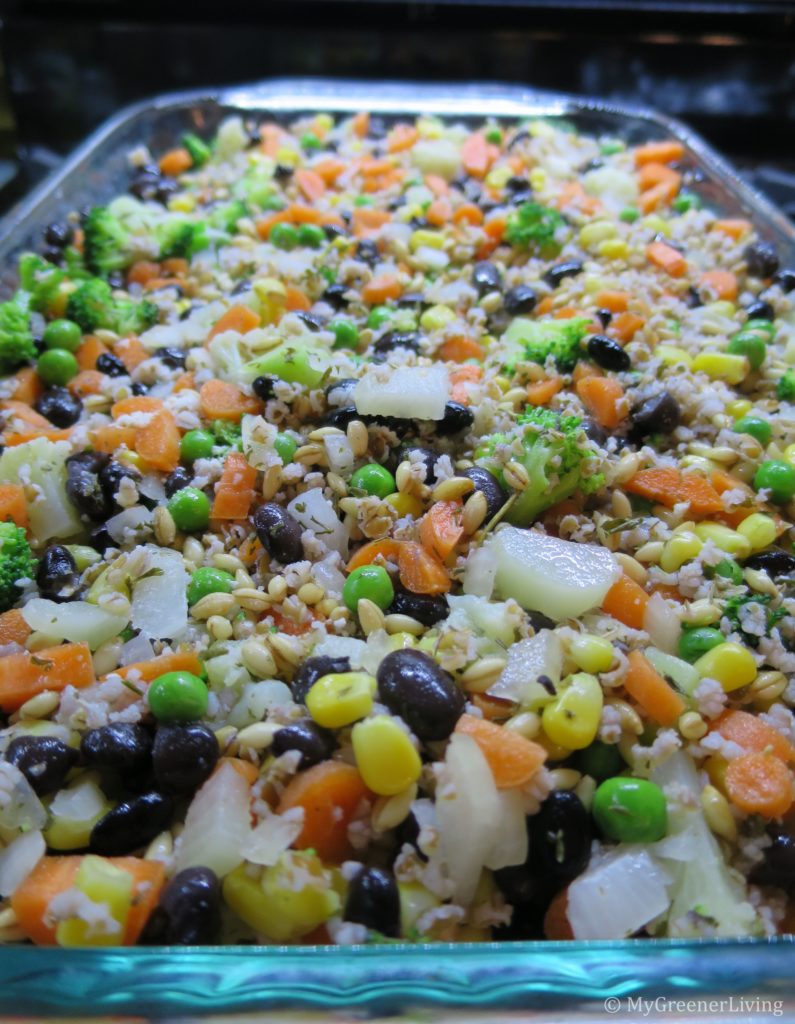
I have heard a lot of people say that they want to eat healthier, but that it is too expensive or takes too long. Over the course of many posts, I hope to share with you that cooking and eating healthy can be done on a budget and in a manageable amount of time. Here is the very first recipe – mixed grain and veggie casserole.
Disclaimer: This post contains affiliate links. See my Disclosure Policy for more information.
Mixed grain and vegetable casserole

The mixed grain and veggie casserole can be prepped in advance, is nutrient-packed, is vegetarian (can be made vegan and gluten free with substitutions) and makes 8-10 servings, depending on how large a serving you like.
Prep time depends on the veggies you purchase. This can be make with fresh, frozen, or canned veggies. I like to use fresh, in-season vegetables whenever I can. In the winter, I often use frozen vegetables, since they are nutrient-dense. Frozen veggies are picked at peak freshness and ripeness and flash-frozen which preserves their nutrients. I avoid canned vegetables because they tend to be mushier and I dislike this consistency, and many cans contain plastic liners. I avoid plastic in general, and avoid heating food in plastic due to my concern with plastic leaching into my food.
Using all fresh vegetables will take longer to prep since you need to wash and chop (and peel, if desired) all the veggies, but I usually prefer the texture of fresh veggies. Using pre-cut fresh veggies, frozen chopped veggies, or chopped canned veggies will save some prep time.

I love this meal because it can be prepped in advance then just popped in the oven the night I want to cook it. It is also very versatile, I swap out different veggies based on my taste preference and veggies I have available the day I am cooking. It is packed with a variety of vegetables, and it makes a lot of food relative to the amount of prep work that goes into making this meal.
My inspiration for this recipe came from Better Homes and Gardens New Cook Book, 1996.
Mixed Grain and Veggie Casserole Recipe
Serves: 8-10
Prep time: 20-40 minutes
Cook time: 1 hour 5 minutes
This recipe is very versatile and can be made with different grains, vegetables, and beans. The basis is 5-6 cups vegetables, 1.5 cups grains, and 2 cups beans. Mix it up based on personal preferences and what ingredients are on hand. This recipe is one of my favorite combinations of ingredients.
Ingredients:
4 medium carrots (225 grams, 1.5 cups chopped), scrubbed, halved lengthwise and sliced thin
1 cup (85 grams) chopped broccoli
1 cup (110 grams) chopped cauliflower
1 cup (110 grams) corn
1 cup (127 grams) peas
1 cup (120 grams, 1 medium) chopped sweet onion
2 cups cooked black beans (just over 1 can, or about 1 cup (194 grams) dry)
1 cup (184 grams) barley (I use hull-less)
1/2 cup (94 grams) bulgar
1.5 Tablespoons dried parsley
1/2 teaspoon garlic salt (if using salted beans, I use garlic powder)
2 cups water or broth
1 cup (112 grams) shredded cheese OR 1/2 cup (23 grams) nutritional yeast
2 Tablespoons apple cider vinegar (if soaking – see my cooking basics for info about soaking grains)
Instructions:
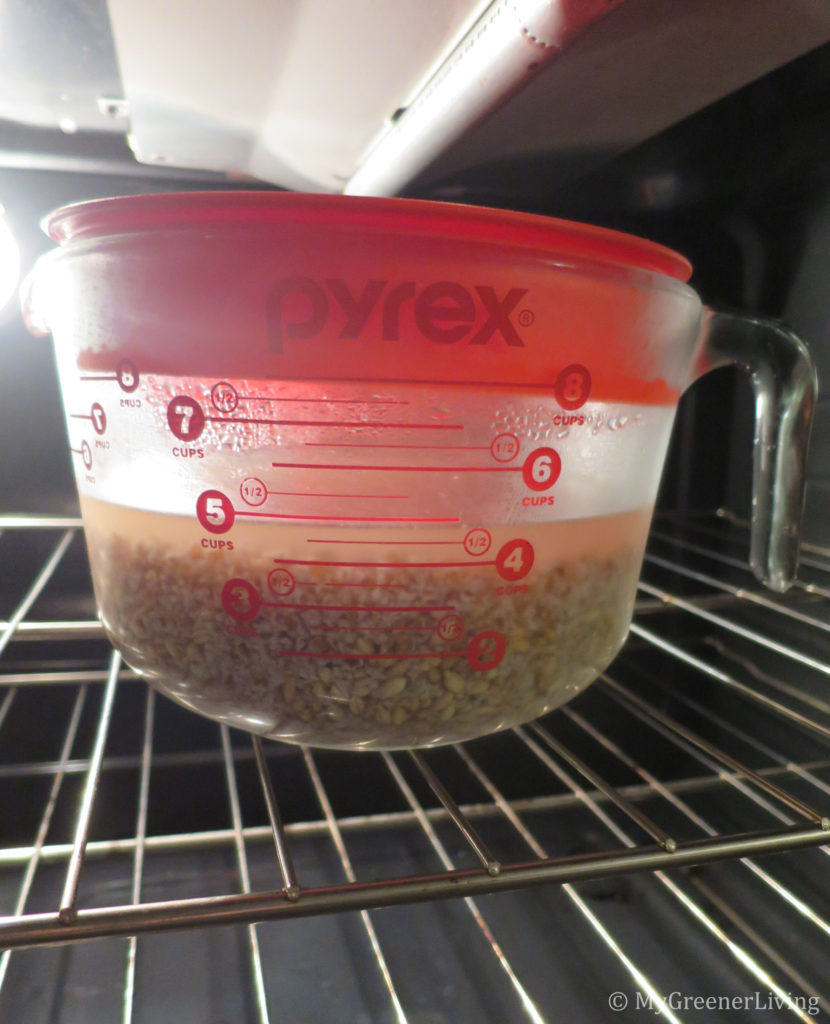
- If soaking: Measure 4 cups of water and heat to lukewarm (I microwave on high 3-4 minutes; exact temperature is not critical). Add 2 tablespoons apple cider vinegar to the warm water. Combine the grains with the water/vinegar in a bowl that holds at least 5 cups (I use my 8-cup Pyrex measuring cup), cover, and leave in a warm (or at least room temperature) location for 12-24 hours. In the winter when room temperature is lower, I often will turn the oven on for a few minutes to warm up, then turn the oven off, put the soaking grains in the oven, and close the door.
- Chop and measure all veggies. Place in a 9″ x 13″ (3 quart) or larger baking dish. Add the garlic salt/garlic powder and parsley. Rinse and drain black beans and add to casserole dish. If prepping in advance, cover and put in the refrigerator until ready to cook.
- When ready to cook: Preheat the oven to 350° Fahrenheit (177° Celsius).
- If soaking grains, drain and rinse the grains then add to the casserole dish. (Just measure the grains and add to the casserole dish if you’re not soaking the grains.)
- If grains were soaked, add 1/2 cup water or broth to the casserole dish. (If grains were not soaked, add 2 cups water or broth to the casserole dish.) Mix all the ingredients together. Cover with aluminum foil.
- Place the covered casserole dish in the preheated oven and cook for about 1 hour, stirring once about halfway through.

- Uncover and top with grated cheese or nutritional yeast. If topping with cheese, place back in the oven for about 5 minutes to melt the cheese.
- Allow to cool at least 10 minutes before serving. This pairs great with fresh bread!

This recipe can easily be halved or quartered to make enough for 4 or 2 people, respectively, but I like to make a big batch so I have leftovers. I keep cooked mixed grain and veggie casserole in the fridge up to 1 week, and freeze up to 3 months. 
Mixed Grain and Veggie Casserole Recipe
Adapted by Diana
This recipe is very versatile and can be made with different grains, vegetables, and beans. The basis is 5-6 cups vegetables, 1.5 cups grains, and 2 cups beans. Mix it up based on personal preferences and what ingredients are on hand. This recipe is one of my favorite combinations of ingredients.
Prep Time 30 minutes mins
Cook Time 1 hour hr 5 minutes mins
Total Time 1 hour hr 35 minutes mins
- 4 medium carrots 225 grams, 1.5 cups chopped, scrubbed, halved lengthwise and sliced thin
- 1 cup 85 grams chopped broccoli
- 1 cup 110 grams chopped cauliflower
- 1 cup 110 grams corn
- 1 cup 127 grams peas
- 1 cup 120 grams, 1 medium chopped sweet onion
- 2 cups cooked black beans just over 1 can, or about 1 cup (194 grams dry)
- 1 cup 184 grams barley (I use hull-less)
- 1/2 cup 94 grams bulgar
- 1.5 Tablespoons dried parsley
- 1/2 teaspoon garlic salt if using salted beans, I use garlic powder
- 2 cups water or broth
- 1 cup 112 grams shredded cheese OR 1/2 cup (23 grams) nutritional yeast
- 2 Tablespoons apple cider vinegar if soaking
1. If soaking: Measure 4 cups of water and heat to lukewarm (I microwave on high 3-4 minutes; exact temperature is not critical). Add 2 tablespoons apple cider vinegar to the warm water. Combine the grains with the water/vinegar in a bowl that holds at least 5 cups (I use my 8-cup Pyrex measuring cup), cover, and leave in a warm (or at least room temperature) location for 12-24 hours. In the winter when room temperature is lower, I often will turn the oven on for a few minutes to warm up, then turn the oven off, put the soaking grains in the oven, and close the door.
2. Chop and measure all veggies. Place in a 9" x 13" (3 quart) or larger baking dish. Add the garlic salt/garlic powder and parsley. Rinse and drain black beans and add to casserole dish. If prepping in advance, cover and put in the refrigerator until ready to cook.
3. When ready to cook: Preheat the oven to 350° Fahrenheit (177° Celsius).
4. If soaking grains, drain and rinse the grains then add to the casserole dish. (Just measure the grains and add to the casserole dish if you're not soaking the grains.)
5. If grains were soaked, add 1/2 cup water or broth to the casserole dish. (If grains were not soaked, add 2 cups water or broth to the casserole dish.) Mix all the ingredients together. Cover with aluminum foil.
6. Place the covered casserole dish in the preheated oven and cook for about 1 hour, stirring once about halfway through.
7. Uncover and top with grated cheese or nutritional yeast. If topping with cheese, place back in the oven for about 5 minutes to melt the cheese.
8. Allow to cool at least 10 minutes before serving. This pairs great with fresh bread!
This recipe can easily be halved or quartered to make enough for 4 or 2 people, respectively, but I like to make a big batch so I have leftovers. I keep cooked mixed grain and veggie casserole in the fridge up to 1 week, and freeze up to 3 months.
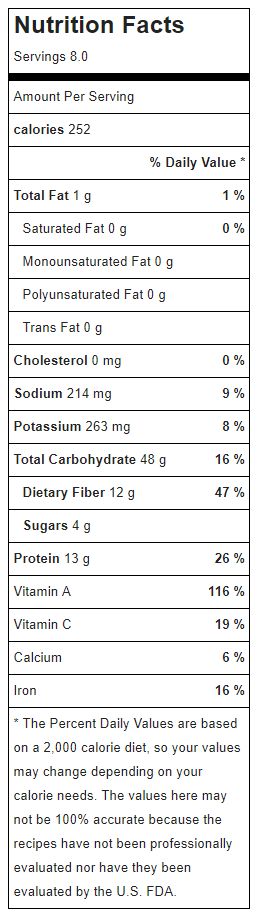
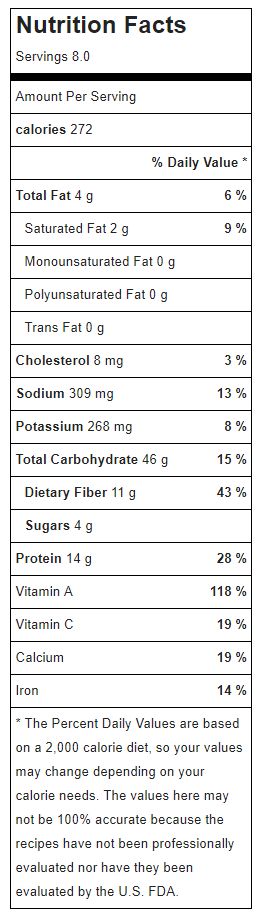
Adapted from New Cook Book by Better Homes and Gardens Nutrition, per 1/8 batch
When prepared as listed in my recipe above, using nutritional yeast:
 When prepared as listed in my recipe above, using reduced fat Mexican blend cheese:
Cost
Cost depends greatly on which vegetables are used in the recipe, and if the veggies are in season. This cost is an estimation based on recent prices I have found. It’s winter and most veggies are out of season here in New England, so the best prices were on frozen, not fresh, items. I keep my eye out for coupons and sales, and stock up on frozen veggies when I can get a great price. The prices below are the prices at which I can regularly find the items.
Cost Breakdown
Carrots: $1.29 for 1 lb (454 grams) baby-cut carrots. $1.29x(225g/454g)=$0.64
Broccoli: $7.99 for 4 lbs (1814grams) organic frozen chopped broccoli florets. $7.99x(85g/1814g)=$0.37
Cauliflower: $7.99 for 4 lbs (1814grams) organic frozen chopped. $7.99x(110g/1814g)=$0.48
Corn: $1.49 for 1 lb (454grams) organic frozen corn. $1.49x(110g/454g)=$0.36
Peas: $1.49 for 1 lb (454grams) organic frozen peas. $1.49x(127g/454g)=$0.42
Onion: $3.49 for 3lbs (6 medium onions). $3.49x(1 onion/6onions)=$0.58
Black Beans: $2.49 for 2 lb dry beans (908 grams). $2.49x(194g/908g)=$0.53
Barley: $2.29 for 26oz (737grams) barley. $x(184g/737g)=$0.57
Bulgar: $3.19 for 28oz (793grams) bulgar. $3.19x(94g/793g)=$0.38
Parsely: $4.99 for 2 oz (56 gram, 37 Tbsp). $4.99x(1.5Tbsp/37Tbsp)=$0.20
Garlic Salt: $0.99 for 8 oz (227 gram, 43.5 tsp). $0.99x(0.5tsp/43.5tsp)=$0.01
Water: essentially free
*Sargento reduced fat Mexican Blend Cheese: on sale $2.00 for 8oz (227grams). $2.00x(112g/227g)=$0.99
*Nutritional Yeast: $6.99 for 8oz (227grams). $6.99x(23g/227g)=$0.71
Apple cider vinegar (if soaking – see my cooking basics for info about soaking grains) $0.99 for 32fl oz (64Tbsp) $0.99x(2Tbsp/64Tbsp)=$0.03
*Since the cheese costs more than the nutritional yeast, I used the cost of the cheese in the total cost calculation.
Total cost: $5.56 for 8 servings; $0.70 per serving.
This recipe was made with mostly organic ingredients and lots of nutritious ingredients! And it costs less than $1 per serving! Depending on your personal preference, you may even get more servings per batch – I typically get 10 servings out of this batch, making the cost just $0.56 each!