Last year I wrote a post about a natural deodorant that I have been using. The deodorant seemed to work fairly well for me, but I wanted to experiment more with the natural deodorants that were wax- and butter-based. I previously experimented with baking soda and arrowroot powder homemade deodorant. I think baking soda is pretty harsh on my sensitive skin, so I ruled that out as a potential ingredient. Arrowroot powder was fine, but I wasn’t really thinking it was doing much. So I poked around a bit online and came across this awesome post from Tracy at The Things We’ll Make.
Disclaimer: This post contains affiliate links. See my Disclosure Policy for more information.
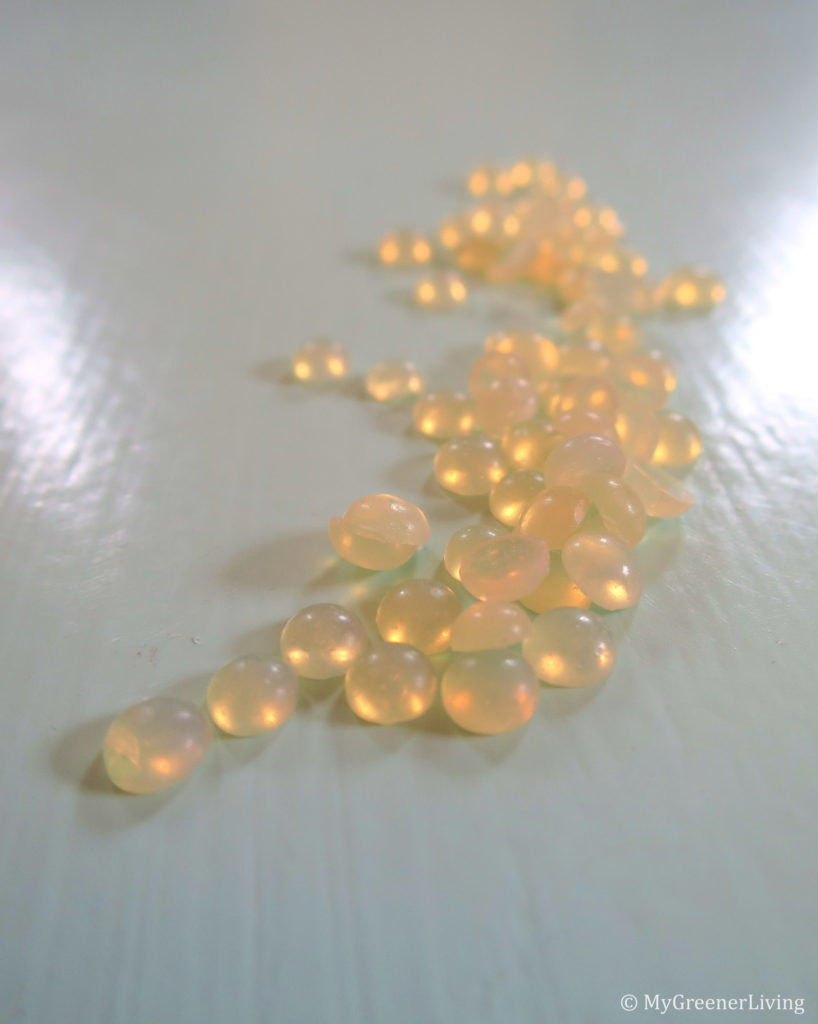
I had almost all of the ingredients for this natural homemade deodorant, and the one I did not have intrigued me the most. Zinc ricinoleate. I have never heard of this ingredient, but upon researching it, I came to the same conclusion as Tracy from The Things We’ll Make, that, while scientists still do not understand why, zinc ricinoleate works at a powerful deodorizer.
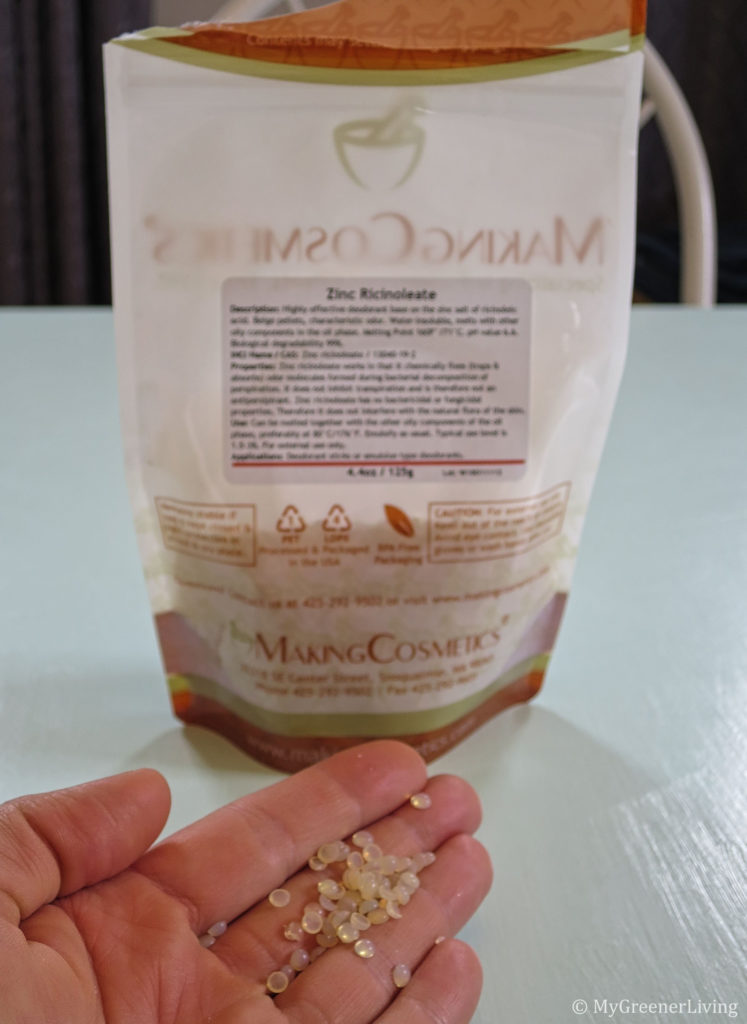
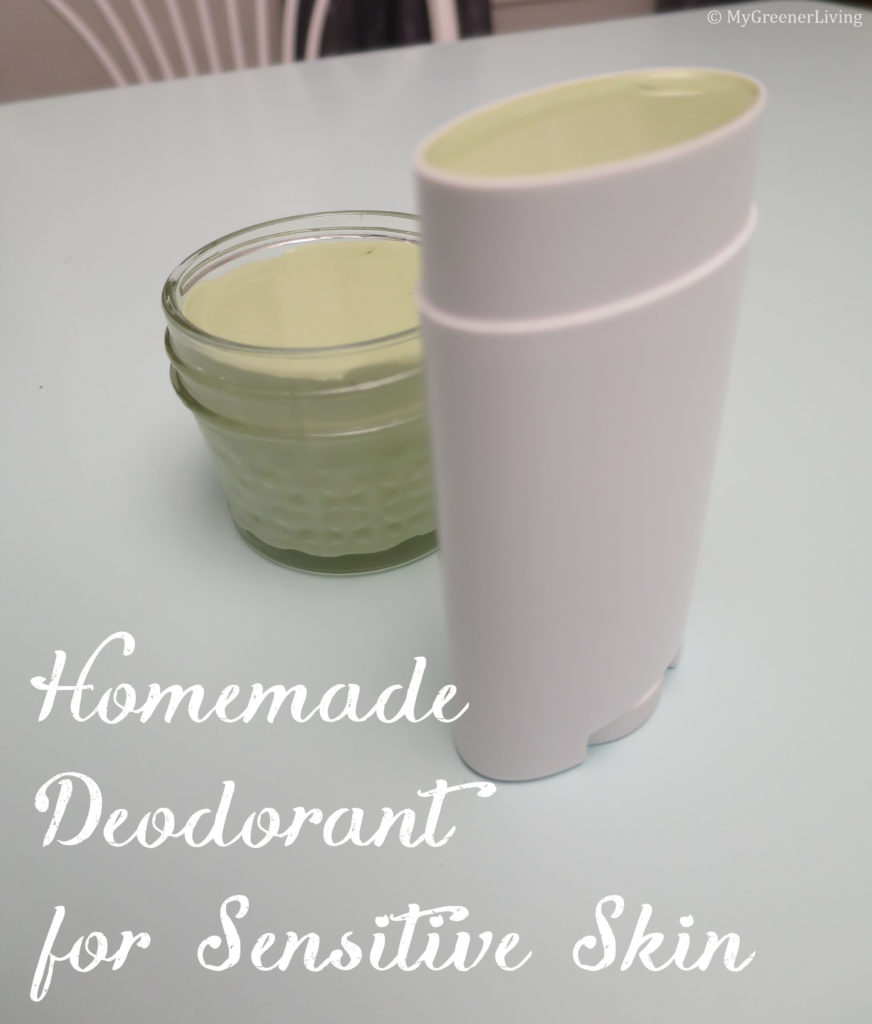
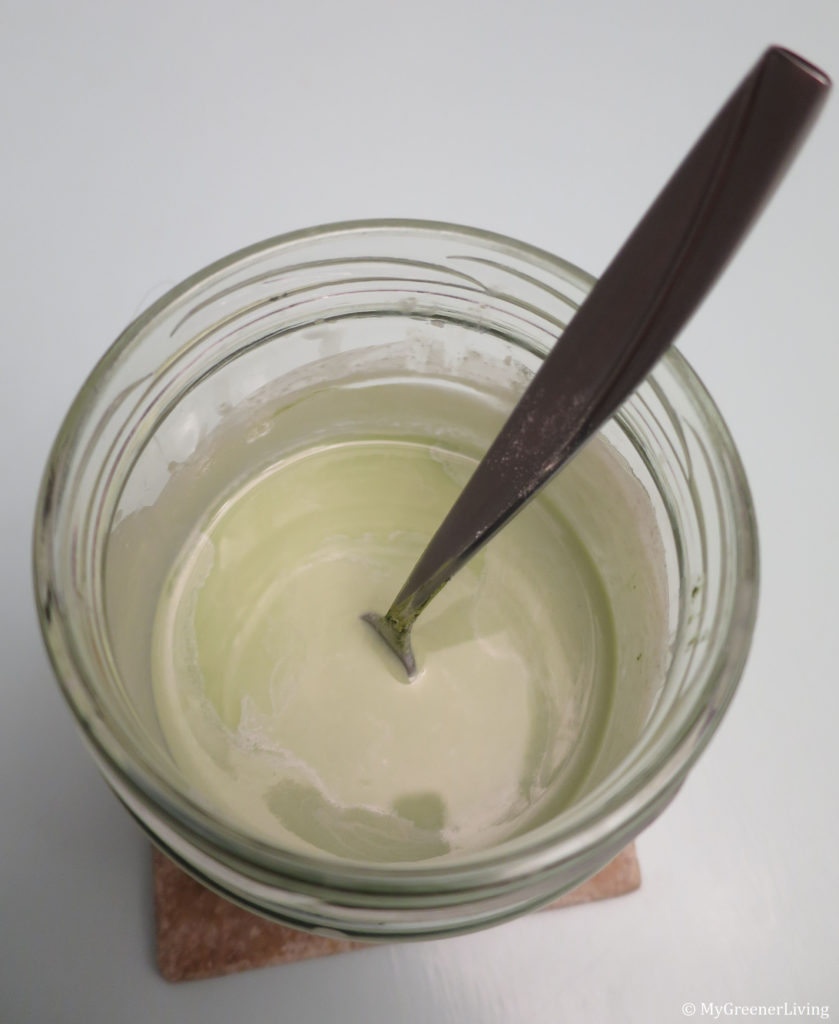
I promptly purchased zinc ricinoleate on Amazon and, as soon as it arrived, I mixed up a batch of Tracy’s deodorant. After my initial trial with Tracy’s recipe, I made some modifications to better suit me. The original recipe was too soft for me, it painted my underarms light green and I knew I would go through the deodorant stick in no time. I thickened my natural homemade deodorant using beeswax, and used two different essential oils to suit my scent and oil property preference.
I haven’t tried this recipe in the winter to see if it is too solid, but I have stored and used it from about 60°F to 85° F, and it has been the perfect consistency for me. It even sat in a car with 95° F outside air temperatures and did not melt. Enough comes off when I wipe it over my underarms to provide deodorizing protection, but it only very slightly lightens my skin. (If you have dark skin you may notice a lightning from the zinc oxide, but I don’t know for sure, I have very pale skin.)
Homemade Natural Deodorant for Sensitive Skin

Ingredients
- 2-1.75 oz deodorant tubes or other container for storing doedorant
- 25 g shea butter
- 40 g coconut oil
- 30 g beeswax pellets
- 15 g zinc oxide
- 3-3.5 g zinc ricinoleate (package recommends 1.5-3%, this yields 2.5 to 3% concentration)
- 1/2 tsp.(2g) matcha
- 10 drops vitamin E
- 15 drops tea tree essential oil
- 7 drops lavender essential oil
- 7 drops eucalyptus oil
Instructions
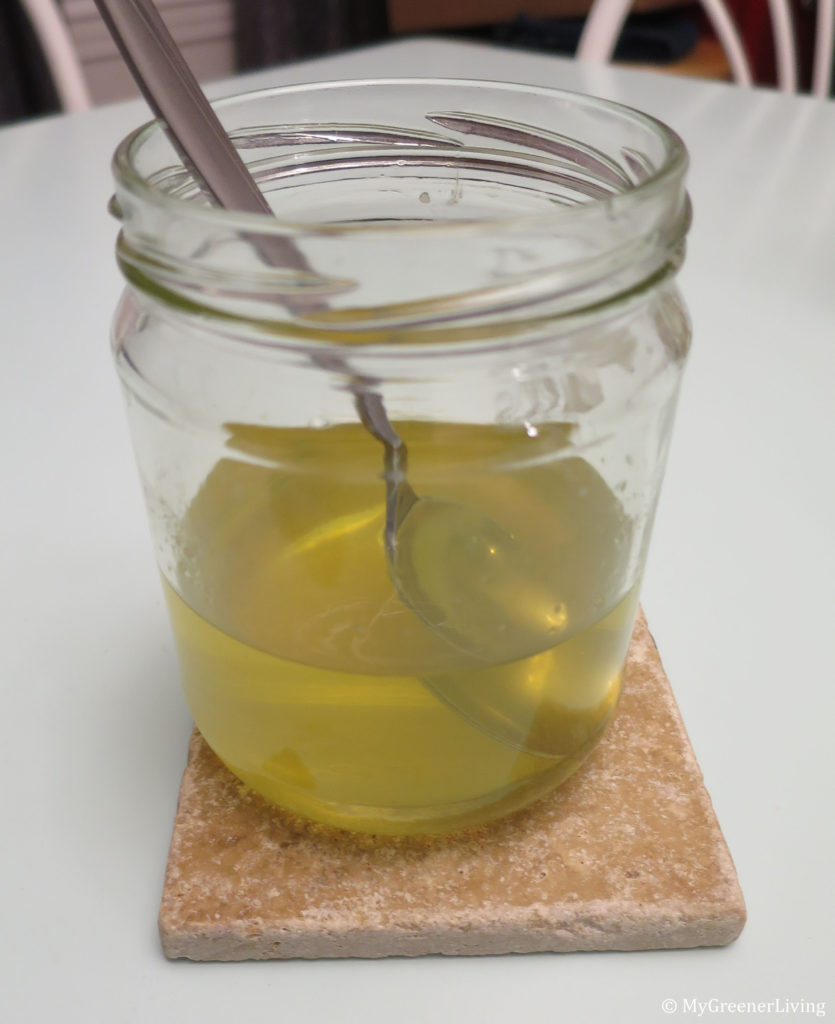
- Combine the bees wax, shea butter, and zinc ricinoleate in the top of a double boiler or microwave safe container. Heat slowly- I do 50% power in my microwave for a minute then add 30 seconds, stir, add 30 seconds, repeat until all ingredients are melted. Stir until all ingredients mixed together.
- Add the zinc oxide and mix well.
- If using matcha, add matcha and mix well.
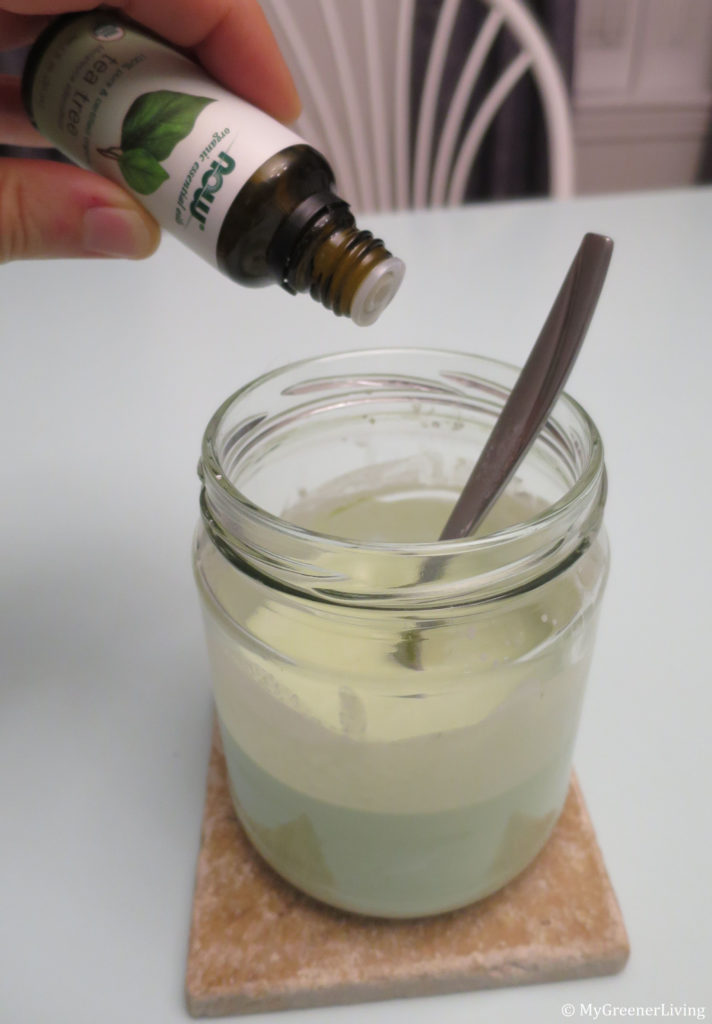
- Add vitamin E and desired essential oils and mix well.
- Pour into a deodorant container or other container of your choice and allow to cool at room temperature. (If accelerating the cooling process such as by placing in the refrigerator, there will be a bigger indentation in the center due to uneven cooling rate.)
Any time after the deodorant has fully cooled, it is ready to be applied.

Use
I apply this natural homemade deodorant each morning, and after each shower. 2 swipes per arm to fully cover the underarm does the trick for me.

Does this natural deodorant work?
This homemade deodorant keeps the stink away
For me, absolutely YES! It seems to work better than any deodorant than I have ever used, natural or conventional. At the end of the day I don’t stink, and the underarm area of my clothing has no sweat smell. At all. And I have tested this well. I have used it before my sweaty cardio workouts in 70+°F humid days in coastal New England. I have worn this when exploring South Korean cities and mountains on 80+°F humid days. This deodorant got me through the 90+° F heat wave in Vermont the week of July 4th. And I sweat a LOT. Since this is a deodorant only and not and antiperspirant, my body keeps sweating (which is GOOD, healthy, natural) but stays stink-free 🙂
I previously had been using Crystal Stick body deodorant. And for a commercially available natural option, it still works a bit. No one ever said I smelled (and I asked my friends who I trust be honest). But my shirts would definitely smell a bit after a workout or a particularly hot sweaty day.
This homemade deodorant keeps my sensitive skin happy
Also, when using Crystal Stick, I developed red, pimple-like bumps on my underarms. I thought this was just due to sweat since it flared up in the heat and after more intense workouts. But I read on other blogs that some people had irritation from the crystal deodorants. After using this oil-based natural homemade deodorant recipe for a few days, it seemed like the bumps were starting to disappear. 2 weeks later, almost all the red bumps disappeared, and after a month every last bump was gone. Two of these 4 weeks were spent in warm, humid South Korea where I was sweating a LOT. Three months after starting use of this deodorant, I had one bump develop, but it only lasted a couple days rather than weeks. Time will tell if the bumps stay away, but already I’m more comfortable than I was using the Crystal Stick.
Pros
- It works better than anything else I’ve ever used
- It smells nice and I can make it smell like anything I want
- It doesn’t melt in the summer and travels well
- It doesn’t require water to apply (like my previous favorite, Crystal Stick)
- It’s filled with nourishing, good-for-my-skin ingredients
- It doesn’t clog my pores and lets my body naturally sweat
- I love how it feels on my skin
- Inexpensive!
Cons
- Due to the high wax content, soap does not fully remove it from my skin so it tends to clog my razor when I shave.
- It’s not commercially available so it takes some effort to make.
- The zinc may discolor some skin tones
What if I was trying to avoid a certain ingredient in this recipe?
Each ingredient in this recipe was selected for a specific reason.
- Beeswax pellets – critical to consistency of the deodorant stick. Antibacterial, antiviral, and anti-fungal. Possibly a similar consistenct could be reached using large amounts if cocoa butter, with shea butter and less coconut oil than this recipe.
- Shea butter – key to the consistency of the deodorant stick, but different combinations of oils/butters/waxes (beeswax, cocoa butter, coconut oil, olive oil) could result in a good substitute deodorant stick base.
- Coconut oil – key to the consistency of the deodorant stick, but different combinations of oils/butters/waxes (beeswax, shea butter, cocoa butter, olive oil) could result in a good substitute deodorant stick base. Also, believed to be antibacterial, antiviral, and anti-fungal.
- Zinc oxide – soothing for skin, skin protectant, and safe according to chemicalsafety.org, WebMD, and others. It could be omitted or used in a lesser quantity, but it does seem to thicken the deodorant, so it may be necessary to increase the amount of shea butter and/or beeswax if zinc oxide is omitted.
- Zinc ricinoleate – This is the odor absorber, I will never make deodorant without it again.
- Matcha powder – antioxidant, and adds fun (and natural!) color. This is used in such low quantity in this recipe that it could probably be omitted with no other substitutions.
- Vitamin E – antioxidant. This could likely be omitted without negatively impacting the recipe.
- Tea tree essential oil – is antibacterial, antiviral, and anti-fungal so for me a great choice for me to use on this area that is prone to irritation.
- Lavender essential oil – antioxidant, helps heal skin, fragrance.
- Eucalyptus oil – antibacterial, antimicrobial, fragrance.
- The oils can be substituted for other essential oils to suit desires for specific scents or properties.
Cost for 2-1.75 oz tubes
- Shea butter, $11.50 for 1lb. 25 grams x (1lb/453.6gram) x ($11.50/lb)=$0.634
- Beeswax, $18.95 for 2 lb. 30grams x (1lb/453.6gram) x ($18.95/2lb)=$0.627
- Coconut oil – $16.04 for 54oz at BJ’s wholesale club. 40 grams x (1oz/27.02 grams) x ($16.04/54oz) = $0.440 (also available on Amazon though a bit more pricey. Still a good deal!)
- Zinc oxide, $10.99 for 1 lb. 15g x ($10.99/1 lb) x (1 lb / 453.6g) = $0.363
- Zinc ricinoleate $15.95 for 125g. 3.5g x ($15.95/125g)=$0.447
- Matcha, $14.99 for 8oz (227g). 2g x ($14.99/227g)=$0.132
- Vitamin E, $5.71 for 2.5 oz or 296-5 drop servings. $5.41/296 servings x 2 servings = $0.039
- Tea Tree Oil, $10.64 per fl oz. 600 drops oil per ounce. 15 drops x (1 fl oz/600 drops) x ($10.64/fl oz) = $0.266
- Eucalyptus Oil, $8.69 per fl oz. 600 drops oil per ounce. 7 drops x (1 fl oz/600 drops) x ($8.69/fl oz) =$0.101
- Lavender Oil,$14.64 per fl oz. 600 drops oil per ounce. 7 drops x (1 fl oz/600 drops) x ($14.64/fl oz)=$0.171
- Deodorant tubes, $8.95 for 5. $8.95 / 5 tubes x 2 tubes = $3.58
Total: $3.22 for 2 tubes worth of deodorant, $6.80 for 2 tubes of deodorant, including tubes. $3.40 for 1 tube of deodorant with tube. Once I use up these deodorant sticks, I can sanitize and reuse the tubes at only $1.61 per deodorant! Each tube lasts me about 12 months, so cost per month is only $0.28. And with reused tubes cost per month will be less than $0.14 per month.
Price comparison
Crystal Stick lasts me about 3 years, or 36 months, so at $6.64 per tube it costs me only about $0.18 per month. But as I noted above, it is not as effective as my natural homemade deodorant and it seems to irritate my skin.
East Creek Organics Rustic Roots Deodorant is a deodorant I found a month or so before I developed this homemade recipe. I really like it – it’s gentle on my skin and contains only ingredients that I consider safe and natural. However, it does not contain any zinc ricineolate, and I don’t find it as effective as my recipe. But the smell is very pleasant and masks sweat smells. Currently I would recommend this as a commercial alternative. $14.99 for a tube, which the manufacturer suggests will last 4 months with daily use, for a monthly cost of $3.75 per month.
Secret Unscented Deodorant and antiperspirant is the deodorant/antiperspirant that I used for years as a teenager and into my 20’s before I adopted the more natural lifestyle. It costs $2.48 for a 2.6 oz tube that lasts 3 months , which equates to about $0.83 per month to use. However I will no longer use this because I dislike antiperspirants and many ingredients in this product. It has an EWG rating of 4, details are at this site.
At a cost of $0.14-$0.28 per month, my homemade deodorant is quite reasonable compared to other deodorants! Once I start reusing tubes, my natural deodorant will not only be the best and most effective for my skin, but the most cost effective, too!

Do you have a favorite effective natural deodorant? Please share with us in the comments below!